Monday, August 22, 2011

Bra, in the ever changing fashion industry

Bra fashion history began as far back as Cretan times, but 1907, was the year when the word brassiere was first reported in an American copy of Vogue. 

In her bra history book 'Bras', Rosemary Hawthorne tells of her collection of brassières and of one that is stamped ' Brassiere. Model 441, British Made ', then of another 2-3 years older marked 'LA CYBELE' (No 18 British Made)'.  By 1915 the magazine 'The Lady' recorded pretty bust bodices or brassieres as essential wear.  Rosemary Hawthorne's bra history book is very informative and she often describes genuine examples of bras, corsets and girdles she has collected or has had donated to her. 
                      
Did movie industry really have any influence in the bra fashion and biz?

Joan Crawford in
Our Dancing Daughers
The 1928 musical Our Dancing Daughters featured Joan Crawford dance her way through in a little more than a very feminine bra and saucy costume.  It was risqué, but no one was complaining.  Tarts were ruling Tinseltown and everyone was cheering.

Fay Wray in King Kong
With the nation in the grip of a paralyzing Depression, Americans sought escape in movie theaters in the form of the 1933 classic King Kong. The filmmakers had the hairy beast striped Fay Wray down to her lingerie. Although this was just an excuse to show the actress in scanty garb but the result was overwhelming. Lacy slips became the fashionable undergarment.  Bras did not decline in popularity; they just got a new companion!
 
Jane Russell in The Outlaw
In 1943, Howard Hughes, the famous part-time filmmaker tycoon and genuine lover of cleavage, incorporated his aerodynamic know-how into the cantilevered bra Jane Russell wore in the movie The Outlaw, allowing the lift to be higher than ever thought possible – so much so that her bosoms appeared to defy gravity!

Taylor in slip
The popularity of Elizabeth Taylor was so immense at the time of the release of her film Butterfield 8 in 1960 which she wore a slinky slip in one scene, the bra sales dramatically slipped for two years as women opted to wear slips instead, just as the purple-eyed icon had done in the movie.

Demi Moore 
The most recent wave hit by Demi Moore on Striptease 1996, putting strippers on pedestal.  Suddenly the occupation became not just acceptable but glamorous.  In real life, young women idolized the stripper look and they were soon buying the same bras and lingerie.

The world has been reminding that a woman’s sexuality was a powerful weapon when Julia Roberts slinked through the tense drama Erin Brockovich 2000 with her signature look throughout the film, the push-up bra that was so effective, the demand for cleavage-enhancing bras became so enormous that Victoria’s Secret invented its Angel bra, and the Wonderbra Company saw sales spike.

White lingerie, which had for decades been thought of as pure and virginal, suddenly seemed kinky when Carmen Electra appeared in Scary Movie 2000 wearing a bra and underwear soaked by sprinklers.  This led to a big box-office with college students for white lingerie.

Quote:  The years teach us patience - that the shorter our time, the greater the capacity  for waiting - Elizabeth Taylor

Thursday, August 18, 2011

The evolution of bra - Part II (The Chronology)

In 1863, Luman L Chapman patented a corset substitute with breast puffs and shoulder-brace straps that tied in back. The first bra was born.

Most of the major designers of the era have tried to lay claim to designing the first bra. Poiret probably had the strongest claim.  What is certain is that all the designers promoted a simple breast retaining garment as better for the newer simple straight dress styles.

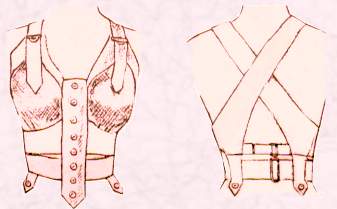
Illustration on the left is referred to a Reform Bodice Bra.  This is the early supposedly healthier Reform Bodice Bra with mesh net cups that gave virtually no support.


In 1889, Corset whiz Herminie Cadolle put together the very first bra that resembles those worn today.  Instead of strapping a contraption around the midsection, Cadolle thought it would be better to use straps around the shoulders because doing so would reduce the stress on the stomach.

In 1893, Frenchwoman Marie Tucek (or Tucke) patented the “Breast Supporter” – the first garment similar to the modern-day bra that used shoulder straps with a hook-and-eye closure to support the breasts in pockets of fabric.

In 1904, the Charles R. DeBevoise Company first labeled a woman's bra-like garment a 'brassiere'. It was a actually a lightly boned camisole that helped stabilize the breasts
Corset substitute with breast puffs 1863
Brassiere 1904
In the costume history of bras these early bras were similar to camisoles tops of the 1980s and 1990s.  Initially at the turn of the 20th century even the word camisole was used too, but replaced by 'Bust Bodice' by 1905.  
Wrap around camisole style bra 

By 1907, the term “brassiere” began to show up in high-profile women's magazines like Vogue especially in America and eventually, around 1912, “brassiere” appeared in the Oxford English Dictionary.

In 1913, New York socialite Mary Phelps Jacob created Mary’s Secret, her own corset replacement out of two silk handkerchiefs tied together with baby ribbon sewn on to make straps and a seam set in the center front. 
Phelps
Her friends were sold on this innovative idea and her backless brassiere was patented in 1914 by Mary under the name of Caress Crosby. It is not thought to be the first bra ever, but it is the first patented record and that gives her the credit. Mary could not get much interest for her idea and sales were minimal, within a short period of time, she sold her patent to Warner Brothers Corset Company for $1,500. Within a year, breasts were measured in inches rather than being categorized small, medium or large. Today, Warner Brothers is a leading name brand manufacturer of bras.

Meanwhile, the corset sang its swan song in 1914 when World War 1 loomed large and women had to enter the workforce, where the tight nuisances were deem too restrictive for such laborious duties as sweeping floors and assembling bombs. In 1917, the government got involved, asking the gentler gender to eschew corsets altogether because they used up too much precious metal – metal that was badly in need of to make tanks and fighter planes.  Women consented and 28,00 tons of metal were save in a year – enough to build tow battleships, can you believe it?

By 1928, Russian-born entrepreneur Ida Rosenthal took the bra to its next stage by introducing cup sizes and bras for all stages of a women's life. She and her husband William started making bras through their New Jersey-based company Maidenform.

The Bra history took on a new dimension when in 1935, Warners introduced four cup sizes called A, B, C and D, but it was well into the 1950s before Britain followed this American standard.  The British corset manufacturers were still using coy descriptions like junior and medium to describe breast fullness. Bosoms were dethroned and separate breasts were really acknowledged.

After 1930 all the brand names we know well in lingerie and corsetry today began manufacturing bras with quite separate cups. They used quality cotton lace and net. One famous bra designed in the 1930s was the Kestos bra and later the Kestos Utility Bra. Its simple seaming looks classy and could be effective today.

In 1947, Frederick Mellinger, founder of the Frederick's of Hollywood, began selling intimate apparel in his Los Angeles stores.

In 1949, Maidenform introduced its famous 'I dreamed' ad campaign. Advertising Age named the 'I dreamed' ads No.28 of the top 100 most memorable advertising campaigns of the 20th century! The earliest ads were drawings of women that were wearing just a bra above the waist in a variety of dream sequences. Tag lines included such greats as, 'I was an Eskimo in my Maidenform bra' and to the updated versions from the late 60s like, 'I dreamed I had the world on a string in my Maidenform bra'.

Fashion history has shown that by the 1950s glamour was what women wanted most. They had been deprived in the war and they had seen the Hollywood stars that had uplift that almost reached their necks.  Brand names like Maidenform, Berlei, Triumph and the British Marks & Spencer bras under the St. Michael label all sold excellent bras that gave the correct pointed circular stitched conical shape of the era.
1950's stitched longline cone bra
The conical bra was the bra that gave the support silhouette for girls who longed to emulate the curves of film star sweater girls like Lana Turner and Jane Russell.  Bra history changed for the better as bras began to be revolutionized by the use of nylon, making them lighter, prettier and easier to wash.  Right - 1950's Stitched Longline Cone Bra.

By 1959, Warners and Dupont had produced Lycra, the renowned stretchy fabric. The result was the true appreciation for jiggle decrease! However by the late 60s, women were burning their bras. When Yves St. Laurent designed a sheer blouse worn without a bra, feminists demanded women burn their bras.  It was all metaphoric and only a dustbin was ever used to dispose of bras. In fact, one such bra burning was staged near the Miss America pageant in Atlantic City, New Jersey in 1968. However this claim has gone down in bra history despite the fact that so few women really abandoned their bras.  Those who needed support knew they could never seriously do without a bra.  But many smaller breasted women did stop wearing bras beneath opaque garments.  Few were really brave enough to do it with a sheer top, but it did herald changes for the decade. 

By the 1960s well designed bras by Exquisite Form, Berlei, Twilfit, Lovable, Silhouette, Playtex and the Marks & Spencer St. Michael range were thought ideal under knitted sweater dresses.

Berlei Bra of 1965
Soon Elastomerics transformed foundation garments with power net fabric.  Early styling found in bra history became out of tune with modern sixties bra design.  The old elastic bra backs and straps were replaced by the newer Courtauld's Spanzelle or Lycra fittings.  Overstretched rotted rubber bits that made bras lose their grip were gone forever. 

By 1964 Rudi Gernreich designed the 'no bra bra' which was light, made of see through stretch netting and very simply shaped, but only really suitable for the small breasted woman.  But from this, the idea of a body stocking in transparent material was developed by Warners in 1965.

The concept simply fitted in with the woman of the 1960s wanting to choose what she did, rather than be told she must wear a bra.  Old habits were changing. Many older women had worn bras to bed believing breasts should be supported during sleep, now bras were removed at night or abandoned altogether as attitudes changed. 

Corsets such as those by Spirella were still worn and were still available.  Longline bras to the waist from Marks & Spencer were very popular to keep that midriff in control.  Re-designing the body contours in the gym was rather unusual then.  To control wayward lumps and bumps one dieted and bought the correct power elastic foundation garments. 

In the 60s many bras like those by Lovable had a very fine layer of foam latex rubber bonded to the top lace fabric and which made the cups stand up on end.  They were comfortable bras that gave a good reliable rather pointed firm shape fashionable at the time.

Ah-a Bra 1972
The 1970s saw the development of the Ah-h Bra (1972) from Sears, and the sports bra in 1977 created by Lisa Lindahl and Polly Smith who sewed two jockstraps together and named it the Jogbra!

And then in the 1990s, the bra industry leaped to a new level in the quest for cleavage by utilizing water, air and silicone pads. Improvements in these developments take us on into the 21st century with companies like Fashion Forms which are mostly about breast management and enhancement.


Stay tune for next story on bra, in the ever changing fashion industry
Quote:  Life is a reciprocal exchange.  To move forward, you have to give back - Oprah Winfrey

The evolution of brassiere

How ladies have been containing themselves through the ages?

Women have used garments designed to secure their feminine assets by lifting, separating and restraining their breasts and tightening the waist, even as early as 2000 BC. In Ancient Rome and Greece, in the third and fourth centuries, women wore simple tunics with no shaping undergarments. This floppy tradition continued on into the twelfth century.

Somewhere in the thirteenth or fourteenth century things began to change. A stiff under bodice called a "cotte" was developed to support the women’s breast and by the fifteenth century it was named a "body" or more appropriately a "pair of bodies" since it was made in two pieces.

The French called this Soutien-gorge breast supporter. The original French meaning was support, but the word was out of use and the French chose to call a bra soutien-gorge.  The Gallic folk even designed their own corset which they named the “bandeau” and by 400AD, theirs was the most fashionable in the Western world, made of linen and frilly lace – call it medieval haute couture! 

It wasn’t the western culture to flare their assets at all.  When religion ruled Europe by 1300, it became increasingly important to hide a woman’s curves, the fairer sex sought corsets that would minimize breasts as much as possible.  By the 1400s women’s chest were covered up to such an extreme that ladies from London to Leningrad were wearing ruffled collars right up to their chins. The only man who would see a lady’s cleavage was her husband.

Chinese Dudou
In China during the Ming dynasty, a form of foundation cloth complete with cups and straps drawn over shoulders and tied to the girth seam at the lower back called a dudou was in vogue among the rich women. While they first arose in the Ming Dynasty, were also common in the Qing Dynasty (1644-1911). In English they are known as 'stomach protectors' or 'tummy covers'.

In England bust improvers were available in the Edwardian period.  By 1905 BBs as they were known were the usual wear. In Spain they added wire, steel, whalebone, and other forms of reinforcements. Unfortunately, it was not a very comfortable garment to wear.

Minoan women on the island of Crete wore bra-like garments that lifted the bare bust out of their clothing. During the 1550s, Catherine de Medicis, wife of King Henri II of France, banned thick waisted women from court functions. It was she who introduced steel corsets. Since the 1500s until the 1800s the corset was the primary under-garment used by women for the purpose of shaping the waist and lifting the breasts.   


Quote: We make a living by what we get, we make a life by what we give - Sir Winston Churchill

Thursday, July 28, 2011

Change of blogs address

Please be informed that our blogs address has been changed to 
http://gsource.blogspot.com

for easy access of our readers.

We thank you for your support and hope to see more article contributions from our readers.

Friday, July 22, 2011

Fabric identification by burning

How to determine fabric content by using burn test.

Snip a piece of fabric equivalent to 1" square.  Using a butane lighter and holding the fabric with a pair of tweezers ignite the fabric over a non-flammable surface in a well ventilated area.Examine the quality and color of the flame, the odor produced, and the  quality of the resulting ash or cinder.  Use this table to help determine your fabric's content.


FABRIC


FLAME
QUALITY


ODOR


ASH
QUALITY


COMMENTS
WOOLorange color
sputtery
burning hair
or feathers
blackish
turns to powder
when crushed
flame will self extinguish
if flame source is removed
no smoke
SILKburns slowlyburning hair
or feathers
grayish
turns to powder
when crushed
burns more easily than wool
but will self extinguish is flame
source removed
COTTONyellow to orange color
steady flame
burning paper
or leaves
grayish, fluffyslow burning ember
LINENyellow to orange color
steady flame
burning paper
or leaves
similar to cottontakes longer to ignite than cotton but otherwise very similar
RAYONfast orange flameburning paper
or leaves
almost no ashember will continue to glow after flame source removed
POLYESTERorange flame, sputterysweet or fruity smellhard shiny  black beadblack smoke
ACETATEburns and melts,sizzlyacidic or vinegaryhard black beadwill continue to burn after flame source removed
NYLONburns slowly and melts,  bluse base and orange tip, no smokeburning celeryhard grayish or brownish beadself extinguish if flame source removed
ACRYLICburns and melts, white-orange tip, no smokeacridblack hard crustwill continue to burn after flame source removed

Plus size lingerie

Some of the lingerie we see available may not be able fit some.  We have available full range of plus size intimate apparel and here are some of them.


Here is how you measure your size

Check out these from our facebook 


Friday, June 10, 2011

What is AQL

The most commonly used standard for product inspections is standard ISO 2859-1 (ANSI/ASQC Z1.4-2003). It uses the concept of AQL, or Acceptable Quality Limit. The standard definition of the AQL is “the maximum defective percent (or the maximum number of defects per hundred units) that, for purpose of sampling inspection, can be considered satisfactory as a process average”.
A sampling size, based on the AQL tables, will be selected and then inspected for defects.
Defects are broken into 3 categories: Minor, Major and Critical. While these can vary from client to client, the typical definitions are as follow:
  • A Minor defect is a discrepancy from the standards, but one that is not likely to affect the usability of an object.
  • A Major defect is one that is likely to create failure of the unit for its intended purpose.
  • A Critical defect is one that is deemed to be hazardous or unsafe.
According to the number of defects found for each type and according to the number of defects allowed (figures given by the AQL tables), your QC can advise you to accept or to reject your shipment.

How to use the AQL Tables?

The AQL tables will help to determine the sampling size we will need to inspect according to your ordered quantity and your level of severity. You can choose Levels I, II or III, with Level III being the most stringent testing and Level I being the least. The standard level, the one used by default and by 98% of the people is the Level II. This is up to the client, but it is the recommended level.
AQL table 1AQL table 2


In order to find the necessary sampling size to be inspected, you must first look at the first chart and find on the left side the range of items being produced in total. For example, if you are producing 8000 items, at Level II you have the letter L, which in the second table corresponds to a sample size of 200.

On the top of the second chart are the defect levels, ranging from 0 to 6.5 (we cut the higher values out of the chart, because they are not relevant for buyers of consumer goods).
You can choose which level to apply for your type of defect: critical, major and minor. Usually most importers will choose standard defect levels which are 0/2.5/4.0 but one can choose 0/1.5/2.5 if he wishes.
Using the standard 0/2.5/4 defect levels and a sample size of 200, we see that if you have more than 0 critical defects, 10 major defects or 14 minor defects, you should reject your shipment.
Of course the decision about what to do after your received the inspection results belongs to you. Most importers will wish to discuss all inspection findings with their vendor/manufacturer in order to improve whatever possible. In case the inspection results are very close to AQL limits, it is important that you double check if the level of found defects is acceptable to you or not.

Quote:  Quality of a product is not what the supplier puts in. It is what the customer gets out and willing to pay for - Peter Drucker